
According to the latest ADASS Spring Survey, over 400,000 people are currently waiting for an assessment, for care to begin, or for a review of their existing care – driven by insufficient funding, workforce challenges and increasing levels and complexity of social care demand.
Due to these pressures, most care package decisions in health and social care rely heavily on brief in-home assessments and self-reported information based on instinct – leaving gaps in how someone is truly coping throughout the day. This is no fault of the person doing the assessment, but rather the lack of access to, and adoption of, crucial technology-enabled solutions across the UK that can provide the evidence to commission with confidence and support our struggling care system.
At Canary Care, we’ve always believed in the power of data to help vulnerable individuals live independently in their homes, while supporting the delivery of the UK Government’s 10-Year Health Plan. Access to real-time insight across an individual’s entire 24 hours paints a cohesive picture of how they’re really coping at home – allowing for accurate, confident care package allocation to support not only the individual, but the people caring for them too.
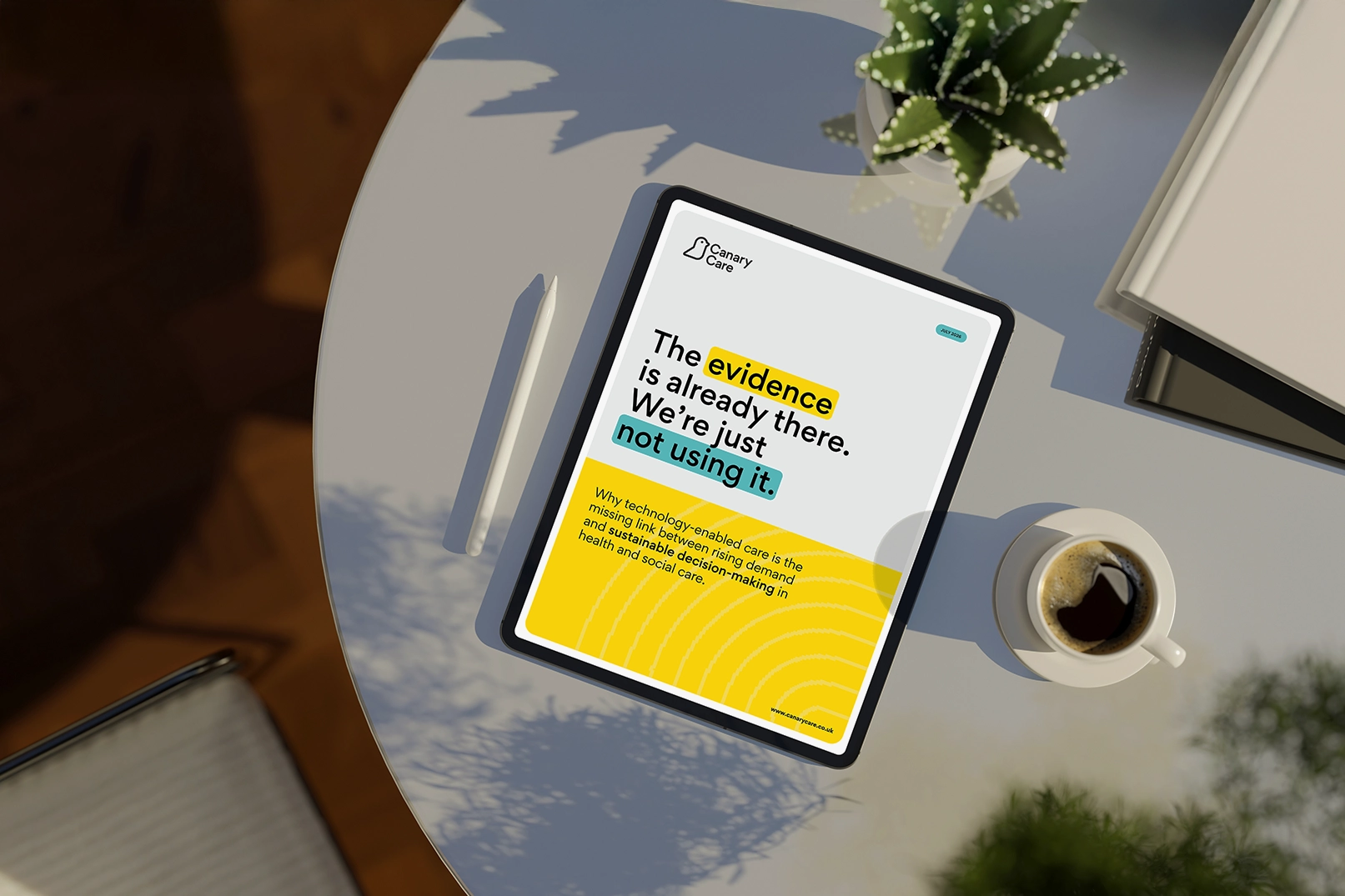
Here’s how digital solutions, such as Canary Care’s activity monitoring system, are already changing care package decisions across the country, and why we’ve published our latest white paper to make the full case for mass adoption.
Why short care package assessments are missing the full picture of an individual’s daily routine
Short observations during a social services care package assessment provide an inaccurate snapshot of a person’s true daily needs. Within a single visit, professionals have no way of seeing:
- Routines during the early morning, later evening or throughout the night.
- Repeated activity that could be a sign of physical or mental decline.
- Gradual changes, such as disturbed sleep, skipped meals or reduced movement.
- How the individual is coping when no one is present and watching.
When someone knows they’re being assessed, particularly when they fear losing their independence, they’ll often present a more positive, able version of themselves. For vulnerable individuals living with dementia, this is often referred to as ‘show timing’, where the individual can display ‘normal’ behaviour in front of a medical professional. Equally, someone experiencing difficulty in the morning can come across far less capable than they usually are day-to-day. Neither are dishonest, but both are significantly incomplete, and yet these are the very moments that care packages are commissioned on.
Self-reported insight based on these visits carries similar limitations. Care professionals asking questions such as “How are you sleeping?” or “Are you managing to get up the stairs?” rely on the individual accurately recalling patterns that they may not even be aware of. As a result, professionals are left to bridge these evidence gaps with instinct, often commissioning support for ‘just in case’ purposes rather than based on genuine need. This stretches already limited budgets, care hours and workforce capacity, while risking the independence that keeping someone at home is meant to protect. It’s here that continuous, non-intrusive insight from tech-enabled solutions can offer that much-needed visibility.
Why is evidence-based insight needed when commissioning health and social care packages?
Rather than relying on what can be seen or recalled during a single care assessment, discreet home sensors placed throughout the home build a detailed picture of an individual’s genuine routine over days and weeks. This captures the crucial hours that an in-person assessment can’t reach, all without the need for invasive cameras or microphones.
Canary Care Hub and Sensors
We’ve designed our system to be totally seamless inside someone’s home – so when professionals are using our tech to carry out assessments, the individual being monitored won’t need to worry about being watched.
Our sensors monitor a range of round-the-clock activity, including general movement, temperature, light and humidity – capturing the crucial moments that often go missed. Whether it be someone getting up frequently throughout the night, going to the bathroom more times than usual during the day, or opening the door at unexpected hours.
Canary Care Portal
Our Canary Care Portal connects that sensor activity to a clear, visual breakdown of daily life, piecing together a full picture that enables care professionals to make care package decisions with confidence and accuracy.
Instead of asking the individual to recall how they’ve been coping at home, practitioners can review weeks of genuine insight alongside their own observations, and commission a care package that best reflects how the person actually lives. Decisions become simpler to justify, easier to review as needs change and far more defensible than just instinct alone.
Nowhere is this evidence-based insight more urgently needed than at hospital discharge. In January 2026, an average day saw more than 13,700 patients across England’s acute hospitals medically fit to leave but not yet discharged – with capacity in onward care the single biggest reason for delay. An NHS care package after hospital, often delivered as a reablement package of care, is typically agreed before anyone knows how well the person will cope once they’re home, meaning discharge planning tends to default to the highest level of support.
Our white paper explores what happens when tech-enabled monitoring is introduced at exactly these decision points. Through real Canary Care cases, the paper examines how objective evidence reshaped care packages at discharge, during reablement and at the point of assessment – and why the biggest barrier to wider adoption is rarely the technology itself.
Who benefits from outcome-based care commissioning?
There’s a workforce reality behind all of this too. Even with the sector’s vacancy rate at a 10-year low, there are still around 96,000 unfilled care posts across England on any given day. This is roughly three times the vacancy rate of the wider economy, with Skills for Care projecting a further 410,000 posts will be needed by 2040 to keep pace with our ageing population. In a system this stretched, every hour of care delivered where it isn’t genuinely needed is an hour taken away from someone who needs it more.
This is exactly what outcome-based care means in practice – shaping support around what actually improves an individual’s life, rather than simply the number of hours delivered. And when care packages are commissioned on evidence rather than caution, the benefits reach every corner of adult social care.
- Commissioners gain defensible, auditable decisions, with stretched budgets directed towards genuine need.
- Care professionals get the confidence to increase support, scale it back, or hold off entirely, without second-guessing themselves based on self-reported information.
- Families gain reassurance that a loved one is safe in their own home, regardless of how close they are to them.
- Individuals keep hold of their independence, with support that fits around their life rather than interrupting it.
How could Canary Care support your care package decisions?
In a care system where councils are already planning to make £909 million of savings next year, the difference between commissioning on caution and commissioning on evidence has never been more important. In order to build a health and social care sector that’s fit for the future, technologies like Canary Care need to be more widely adopted to bridge the gap between rising demand and sustainable decision-making.
Download the full white paper here.
If you’re keen to explore how our tech-enabled solutions can support your care organisation, get in touch today! Our team of experts are ready to help.